

The LIGHTWIND Project aims to develop an offshore wind turbine of more than 15 MW based on the OptiGen concept, an innovative modular drivetrain architecture that replaces conventional large main bearings with a wheel-and-rail system located close to the generator air gap.
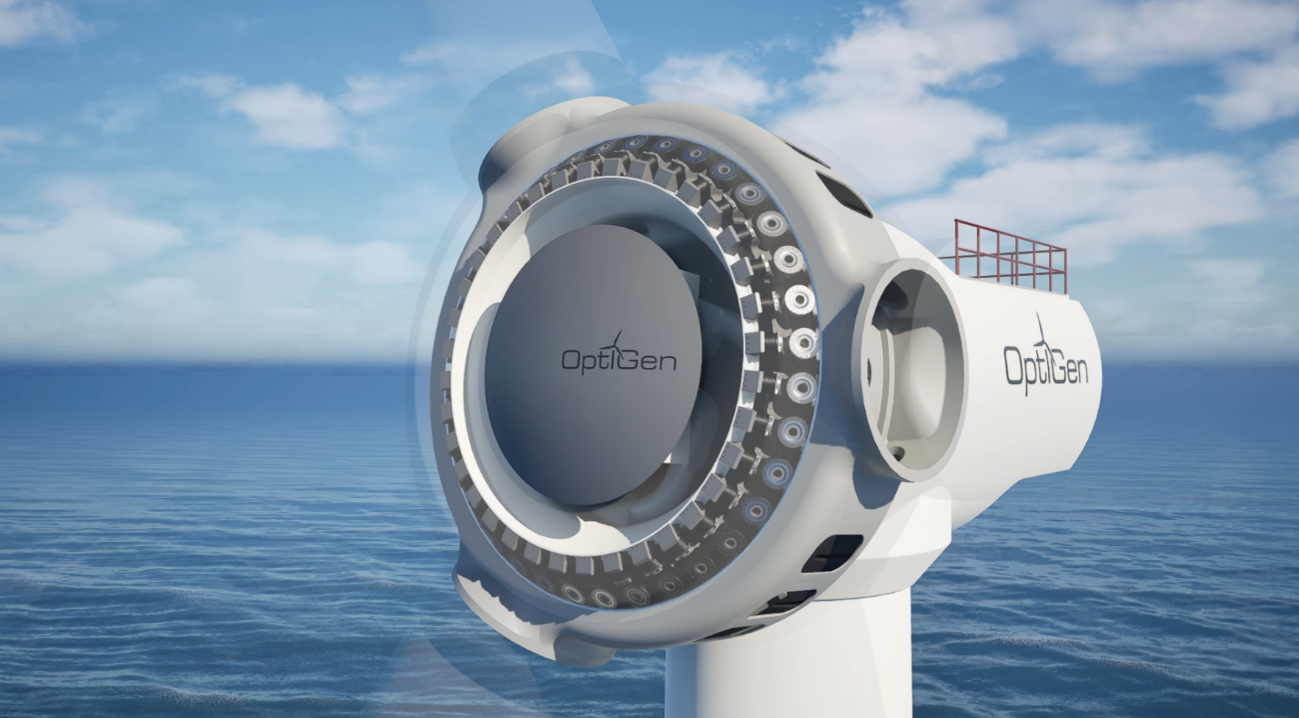
This configuration seeks to address some of the main challenges associated with the increasing power ratings of both onshore and offshore wind turbines, particularly the increase in structural dimensions and loads, component weight, and the difficulties and costs associated with maintenance, especially for offshore turbines.
One of the main advantages of the concept developed within LIGHTWIND, compared with conventional bearings, is its ease of maintenance. The system enables components to be monitored and replaced directly within the turbine, eliminating the need to dismantle and transport the entire nacelle back to an assembly facility.
Starting from a preliminary design based on the IEA Wind 15 MW reference turbine, the most critical components were identified, particularly in relation to fatigue. The operating conditions of the wheels and rails, the loads acting on them, and the materials capable of withstanding these loads were then analysed in detail. A test rig was subsequently developed to reproduce equivalent operating conditions on an accelerated basis and verify the durability of the system.
In parallel, the dynamic behaviour of the mechanical system was reproduced using a hexapod (the Beat 1.1, developed by IDOM and located at the IWES Fraunhofer facilities in Hamburg) enabling the performance of the architecture to be evaluated under some of the most demanding operating conditions.
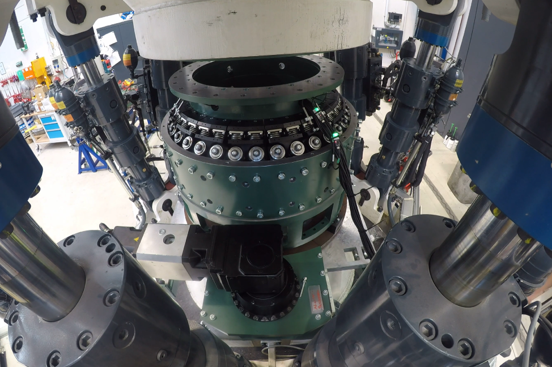
1:10-scale specimen of the OptiGen drivetrain on the Fraunhofer IWES test rig.
The results obtained during this first test campaign have been positive and allow the project to move forward to a new phase of testing. The project’s technical team is currently implementing improvements and adjustments based on the experience gained during the first campaign, with the aim of continuing to validate the concept and further increasing its technological maturity.
As part of the same project, a 22 MW version of the OptiGen system will also be designed using IEA Wind Task 55 as a reference, and its scalability up to 30 MW will be analysed. This will provide an indication of how the architecture could be applied to future generations of very-high-power wind turbines, where the advantages of the technology are expected to become even more significant.
To mark this new milestone, the LIGHTWIND project is releasing an explanatory video outlining the technological challenge addressed by the project, how the OptiGen concept works, and the main design, testing and validation activities carried out to date.
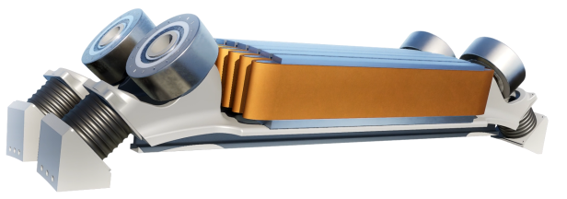
3D detail of one of the key components of the OptiGen design containing the generator coils.
In addition to addressing the technical challenges associated with increasingly large wind turbines, the OptiGen concept can reduce the use of certain critical materials, such as the rare-earth elements used in generator magnets.
The technological development carried out within LIGHTWIND is also enabling new applications of the wheel-and-rail system to be explored beyond the specific scope of the project. OptiGen has assessed alternative applications of the technology to other wind turbine components and architectures. These include, for example, a solution aimed at turbines with geared drivetrain, as well as another solution focused on yaw and blade pitch systems.
The progress and results of the LIGHTWIND project will soon be presented at WindEnergy Hamburg, one of the leading international trade fairs for the wind-energy sector. The project team will present the main results obtained during the first test campaign, the project’s next steps, and the work planned to continue developing and scaling up the concept.
Participation in the event represents a new opportunity to bring the results of LIGHTWIND closer to industry and strengthen collaboration between research centres, engineering companies and industrial partners. This collaboration is one of the project’s fundamental pillars in turning research results into solutions with the potential to deliver a real impact on both the onshore and offshore wind industries.
The LIGHTWIND consortium comprises eight European companies and institutions: TNO in the Netherlands; IWES Fraunhofer in Germany; DIS/Creadis in Denmark; HCMR in Greece; MarinRes in Norway; and Euro-Funding, X1Wind and OptiGen in Spain
Funded by the European Union. Views and opinions expressed are however those of the author(s) only and do not necessarily reflect those of the European Union or the European Climate, Infrastructure and Environment Executive Agency (CINEA). Neither the European Union nor the granting authority can be held responsible for them.
Resources:
Download press release note (English)
Descargar nota de prensa (Español)
Supported by / Thanks to: